Healthy Families Aren’t Always Harmonious
Strong family relationships aren't built by avoiding disagreement. They are built through trust, communication, individuality and our ability to find our way back to one another when things become difficult.
There was a time when I might have described a healthy family environment as a harmonious one.
I'm not sure I would now.
Harmony sounds lovely. And, of course, most of us would prefer our homes to feel calm, connected and relatively peaceful.
But families are made up of people.
Different personalities. Different needs. Different perspectives. Different emotions. Different thresholds. Different ways of communicating and experiencing the world.
Add work, school, friendships, responsibilities, tiredness, finances and the ordinary pressures of everyday life, and expecting harmony all of the time isn't particularly realistic.
Nor, perhaps, should it be the goal.
A healthy family isn't one that never disagrees.
It isn't a home where everybody communicates perfectly, children always cooperate and adults respond calmly to every difficult moment.
There will be misunderstandings.
There will be frustration.
There will be arguments.
There will be occasions when parents and carers get things wrong, and occasions when children and young people do too.
That's not necessarily evidence of an unhealthy relationship.
Perhaps what matters more is what happens next.
Connection matters more than constant harmony
Strong family relationships develop through thousands of ordinary interactions.
How we speak to one another.
Whether we listen when somebody sees something differently.
Whether children and young people feel able to express an opinion we may not share.
How we respond when emotions run high.
Whether we can acknowledge when we've misunderstood something.
And whether, after conflict or disconnection, we can find our way back to one another.
This is where trust develops.
We sometimes think of trust as something that simply exists within close relationships, particularly between adults and children.
But trust is relational.
It grows through experience.
Through consistency. Honesty. Reliability. Listening. Respect. And importantly, through repair when things haven't gone well.
Being the adult in a relationship doesn't automatically mean we will always get it right.
Sometimes one of the most powerful things we can offer a child or young person is the ability to say:
“I got that wrong. I'm sorry.”
That doesn't weaken our position as an adult.
It models something important about relationships.
Communication is about more than getting young people to talk
We often encourage children and young people to communicate.
Tell me what's wrong.
Talk to me.
Tell me how you're feeling.
But communication is a two-way process.
Perhaps alongside asking whether a young person communicates with us, we also need to ask:
How easy are we to communicate with?
What happens when they tell us something we don't want to hear?
Do we listen to understand, or are we already preparing our response?
Can they disagree with us without the disagreement itself becoming the problem?
Do we make assumptions about what behaviour means before becoming curious about what might be happening underneath it?
And do we notice communication that isn't spoken?
Tone. Expression. Withdrawal. Silence. Behaviour. Body language.
Young people don't always have the language to explain exactly what they're experiencing.
Sometimes we need to listen beyond words.
Children learn relationships through relationships
Children and young people learn an enormous amount about relationships through experiencing them.
We can teach a child to listen respectfully.
But they also notice whether we listen respectfully to them.
We can encourage them to apologise.
But they experience something particularly powerful when an adult is able to apologise too.
We can tell them that emotions are normal.
But they also watch what happens when the adults around them experience frustration, anger, disappointment or stress.
We can teach them to respect differences.
But they notice how we respond when somebody's views, choices or experiences differ from our own.
None of this requires perfect parenting.
Children don't need adults who demonstrate ideal responses in every interaction.
What they can benefit from is adults who are willing to reflect, take responsibility and repair when necessary.
We don't only teach children about relationships. We show them what relationships feel like.
Belonging shouldn't require sameness
One of the great challenges of parenting is that the little person whose world we initially shape gradually becomes a person with a world of their own.
Their opinions develop.
Their preferences change.
Their friendships become increasingly important.
Their values begin to emerge.
They may question things we've always taken for granted.
And some of what they eventually believe, choose or value may be different from us.
That isn't necessarily rejection.
It's development.
Strong family relationships need enough space for individuality.
Children and young people need to experience belonging while gradually discovering who they are.
That doesn't mean abandoning boundaries, family responsibilities or expectations.
It means recognising that connection doesn't require everybody to think, behave or experience the world in exactly the same way.
A young person can belong to a family without becoming a replica of it.
And perhaps one of the more difficult transitions parenting eventually asks of us is moving from shaping much of our child's world to gradually making room for them to shape their own.
Our wellbeing enters the relationship too
There is another part of family relationships that I think deserves more attention.
The adults are part of the environment too.
We bring our own experiences, stresses, expectations, beliefs and emotional responses into family life.
When we're tired, overwhelmed or worried, our capacity for patience can change.
We may react more quickly.
Listen less carefully.
Interpret behaviour differently.
None of that makes someone a bad parent.
It makes us human.
But recognising our own wellbeing as part of the family environment gives us another place to become curious.
Not simply:
“Why is my child behaving like this?”
but sometimes:
“What is happening around all of us at the moment?”
What pressures are present?
What does each person need?
What might I be bringing into this interaction?
What might they be experiencing that I can't immediately see?
Sometimes a small change in the environment, expectation or way we communicate can change the interaction itself.
Perhaps repair matters more than getting it right
Family life will never be perfectly harmonious.
And perhaps that's okay.
Relationships don't become strong because nothing ever goes wrong.
They become strong partly through discovering that something can go wrong without the relationship disappearing with it.
We can disagree and reconnect.
We can misunderstand and become curious.
We can react and then reflect.
We can hurt somebody unintentionally and apologise.
We can change our approach.
We can try again.
That experience of repair can teach children and young people something enormously valuable about relationships:
Difficulty doesn't always mean disconnection.
Perhaps that's a much more useful lesson than trying to create a home in which conflict never happens.
Maybe harmony was never the goal
So I'm no longer convinced that harmonious is the word I would use to describe healthy family life.
I'd choose something messier.
Connected.
A connected family can disagree.
A connected family can have difficult days.
A connected family can contain very different personalities, opinions and needs.
A connected family doesn't need perfection.
What matters is whether there is enough trust, communication and respect to navigate those differences.
Whether people can remain individuals and still belong.
Whether we can recognise when something isn't working.
And whether we're willing to find our way back to one another when things become difficult.
Because perhaps the strength of a family isn't measured by how rarely harmony disappears.
Perhaps it's found in our willingness to reconnect when it does.
Karen Smith
The Shift Space
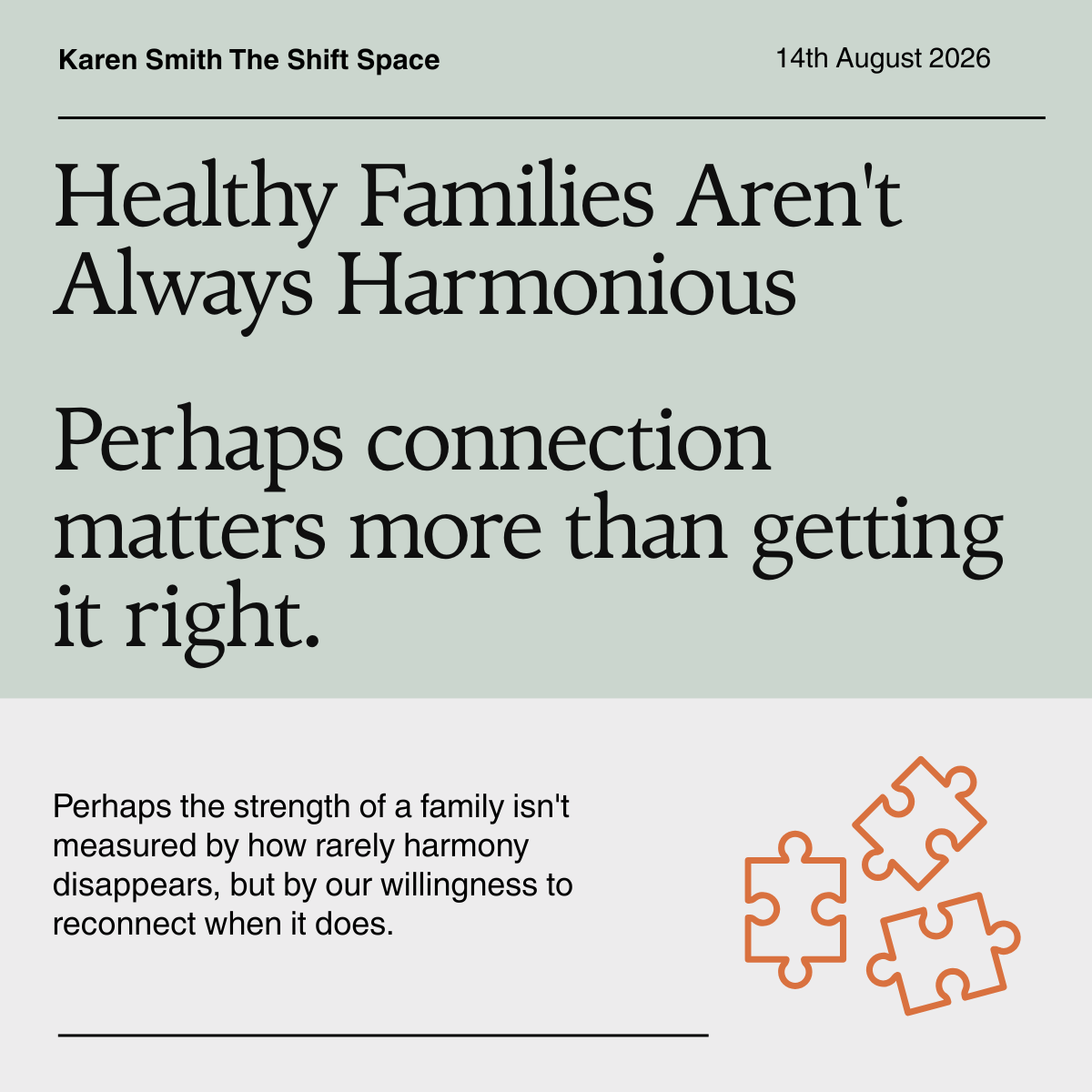
Light green and off white background with text that reads: Title: Healthy Families Aren’t Always Harmonious. Perhaps Connection matters more than getting it right. Sub heading reads: Perhaps the strength of a family isn’t measured by how rarely harmony disappears, but by our willingness to reconnect when it does. There is also an image of three puzzle pieces. Image colour: Orange.